Epoxy Composites Reinforced with Long Al₂O₃ Nanowires for Enhanced Thermal Management in Advanced Semiconductor Packaging
By Zihao Lin 1, Sung-Ting Chen 2, Kyoung-Sik Moon 3, Wen-Hsi Lee 4 and Ching-Ping Wong 5
1 George W. Woodruff School of Mechanical Engineering, Georgia Institute of Technology, Atlanta, Georgia 30332, United States
2 School of Materials Science and Engineering, Georgia Institute of Technology, Atlanta, Georgia 30332, United States
3 3D Systems Packaging Research Center, Georgia Institute of Technology, Atlanta, Georgia 30332, United States
4 Department of Electrical Engineering, National Cheng Kung University, Tainan 701, Taiwan
5 School of Materials Science and Engineering, Georgia Institute of Technology, Atlanta, Georgia 30332, United States
Abstract
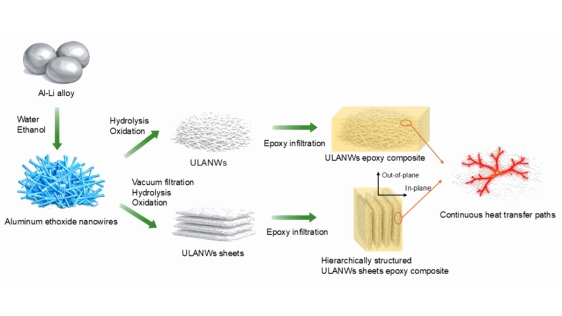
The rapid increase in heat flux in advanced 2.5D/3D semiconductor packaging places stringent demands on thermal interface materials (TIMs), particularly for efficient heat dissipation and thermomechanical reliability. Epoxy-based TIMs offer favorable adhesion and process compatibility but suffer from intrinsically low thermal conductivity, while conventional ceramic fillers require high loadings to achieve thermal percolation, compromising processability. Here, we report epoxy composite TIMs enabled by ultralong Al2O3 nanowires (ULANWs) with millimeter-scale lengths, nanoscale diameters (100–1000 nm), and an extraordinary aspect ratio (∼1000). A scalable fabrication strategy is employed to produce ULANWs, which are incorporated into epoxy matrixes as either randomly dispersed networks or hierarchically structured vertically oriented sheets. The nanoscale diameter and hierarchical nanowire architecture synergistically reduce the junction density, enabling continuity-dominated phonon transport. The interconnected ULANW architecture reduces the interfacial thermal resistance and lowers the thermal percolation threshold. At a filler loading of 28 wt %, the vertically structured composite achieves an out-of-plane thermal conductivity of 0.78 W/(m K), representing a 72.1% enhancement over Al2O3 particle-filled composites and a 452.6% improvement over neat epoxy. Concurrently, the ULANW network suppresses thermal expansion and enhances the stiffness. Thermal testing and finite element simulations confirmed substantially reduced junction temperatures, demonstrating the potential of this architecture for next-generation TIMs in advanced electronic packaging.
KEYWORDS: Ultralong alumina nanowires, Thermal management, Thermal interface materials, Epoxy composite, Advanced packaging
To read the full article, click here
Related Chiplet
- DPIQ Tx PICs
- IMDD Tx PICs
- Near-Packaged Optics (NPO) Chiplet Solution
- High Performance Droplet
- Interconnect Chiplet
Related Technical Papers
- Material Needs and Measurement Challenges for Advanced Semiconductor Packaging: Understanding the Soft Side of Science
- Thermal stability enhancement of low temperature Cu-Cu bonding using metal passivation technology for advanced electronic packaging
- Workflows for tackling heterogeneous integration of chiplets for 2.5D/3D semiconductor packaging
- Intel Delivers Cutting-Edge Process Technologies to the Data Center with Intel 18A and Advanced Chiplet Packaging
Latest Technical Papers
- Epoxy Composites Reinforced with Long Al₂O₃ Nanowires for Enhanced Thermal Management in Advanced Semiconductor Packaging
- Chipmunq: A Fault-Tolerant Compiler for Chiplet Quantum Architectures
- Cross Waveguide Design for Color-Centers in Diamond for Photonic Quantum Computing
- CHICO-Agent: An LLM Agent for the Cross-layer Optimization of 2.5D and 3D Chiplet-based Systems
- A PPA-Driven 3D-IC Partitioning Selection Framework with Surrogate Models