Interconnect-Aware Logic Resynthesis for Multi-Die FPGAs
By Xiaoke Wang 1, Raveena Raikar 1, Markus Rein 1, Ruiqi Chen 1,2, Chang Meng 3 and Dirk Stroobandt 1
1 Ghent University, Belgium
2 Vrije Universiteit Brussel, Belgium
3 Eindhoven University of Technology, The Netherlands
Abstract
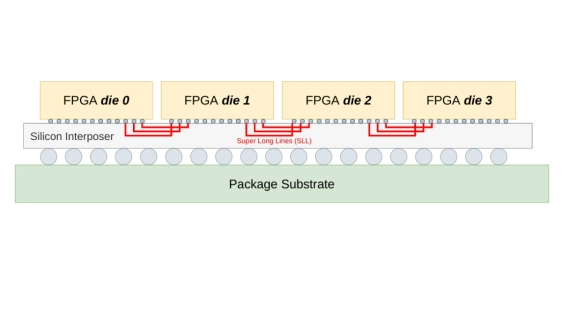
Multi-die FPGAs enable device scaling beyond reticle limits but introduce severe interconnect overhead across die boundaries. Inter-die connections, commonly referred to as super-long lines (SLLs), incur high delay and consume scarce interposer interconnect resources, often dominating critical paths and complicating physical design. To address this, this work proposes an interconnect-aware logic resynthesis method that restructures the LUT-level netlist to reduce the number of SLLs. The resynthesis engine uses die partitioning information to apply logic resubstitutions, which simplifies local circuit structures and eliminates SLLs. By reducing the number of SLLs early in the design flow, prior to physical implementation, the proposed method shortens critical paths, alleviates pressure on scarce interposer interconnect resources, and improves overall physical design flexibility. We further build a tool flow for multi-die FPGAs by integrating the proposed resynthesis method with packing and placement. Experimental results on the EPFL benchmarks show that, compared with a state-of-the-art framework, the proposed method reduces the number of SLLs by up to 24.8% for a 2-die FPGA and up to 27.38% for a 3-die FPGA. On MCNC benchmarks, our tool flow achieves an average SLL reduction of 1.65% while preserving placement quality. On Koios benchmarks, where fewer removable SLLs exist, several designs still exhibit considerable inter-die edge reductions. Overall, the results confirm that reducing inter-die connections at the logic level is an effective approach for multi-die FPGAs.
Key Words: Interconnect, Logic Resynthesis, Multi-die FPGAs
To read the full article, click here
Related Chiplet
- DPIQ Tx PICs
- IMDD Tx PICs
- Near-Packaged Optics (NPO) Chiplet Solution
- High Performance Droplet
- Interconnect Chiplet
Related Technical Papers
- IP for 3D Multi-Die Designs
- Escaping Flatland: A Placement Flow for Enabling 3D FPGAs
- Fleet: Hierarchical Task-based Abstraction for Megakernels on Multi-Die GPUs
- Multi-Die Systems Reshape Semiconductor Innovation
Latest Technical Papers
- Affinity Tailor: Dynamic Locality-Aware Scheduling at Scale
- AMMA: A Multi-Chiplet Memory-Centric Architecture for Low-Latency 1M Context Attention Serving
- Exploring the Efficiency of 3D-Stacked AI Chip Architecture for LLM Inference with Voxel
- Epoxy Composites Reinforced with Long Al₂O₃ Nanowires for Enhanced Thermal Management in Advanced Semiconductor Packaging
- Chipmunq: A Fault-Tolerant Compiler for Chiplet Quantum Architectures