AI Optical Interconnect Boom Drives U.S. Firms to Expand Southeast Asia Outsourcing, Opening the Door for Cross-Industry Entrants
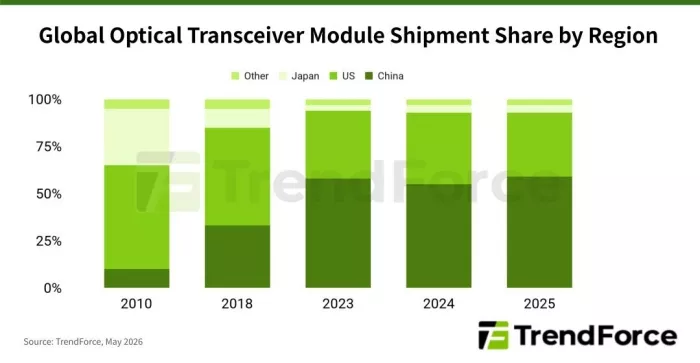
May 5, 2026 -- Global shipment volume of optical transceivers is projected to more than triple from 26.5 million units in 2023 to over 92 million units by 2026, according to TrendForce’s latest AI infrastructure research. This massive market opportunity—combined with geopolitical factors—is driving a restructuring of the global optical communications supply chain. It is also accelerating outsourcing strategies among U.S. vendors in Southeast Asia, creating an entry point for non-traditional technology players to move into AI optical communications.
TrendForce notes that Chinese suppliers, leveraging scale and cost advantages, have long held a dominant position in the global optical communications market. In high-volume segments such as Ethernet transceivers and FTTx, companies like Innolight and Eoptolink maintain strong cost competitiveness that is difficult to challenge.
In contrast, U.S. optical vendors, while benefiting from AI-driven demand, tend to focus on higher-value segments such as dense wavelength division multiplexing (DWDM) and coherent optics. Consequently, they do not fully cover the broader pluggable transceiver market, where standardized, high-volume products remain largely dominated by Chinese suppliers.
However, as CSPs rapidly expand data center deployments, demand for 800G and 1.6T high-speed pluggable optical transceivers is surging. This has prompted major U.S. vendors such as Coherent and Lumentum to shift strategies—from relying primarily on in-house production to adopting a more outsourcing-driven model—to accelerate capacity expansion and diversify supply chain risks.
In response to supply chain risk management and the broader “Out of China” trend, these companies are prioritizing manufacturing partners with established operations in Southeast Asia. This shift is benefiting Taiwanese tech firms with manufacturing and assembly capabilities in the region, enabling them to capture significant spillover orders.
Copper interconnects are approaching bottlenecks in both signal integrity and power consumption at higher transmission speeds, positioning silicon photonics (SiPh) and co-packaged optics (CPO) as key long-term solutions. This evolution is attracting major technology companies that were not previously focused on optical communications.
This also signals a shift in competitive focus, from pure assembly capabilities to the ability to integrate front-end wafer processes with advanced packaging platforms. Unlike traditional optical communications, where the emphasis was largely on module assembly, SiPh and CPO center on wafer-level processes and advanced co-packaging technologies, requiring the development of integrated platforms. As a result, the ability to leverage existing semiconductor infrastructure has become a critical entry point for new entrants into AI optical communications.
TrendForce highlights that Taiwan offers end-to-end integration, spanning wafer foundry (e.g., PIC processes), advanced OSAT packaging (2.5D/3D), high-value optoelectronic hybrid testing platforms, precision optical assembly, and server ODM manufacturing.
For companies seeking to enter this space, early investment in semiconductor-optical integration technologies will not only help avoid price competition in commoditized components dominated by Chinese suppliers, but also align with compliance requirements—positioning them to evolve from component suppliers into key infrastructure partners for next-generation AI data centers.
Related Chiplet
- DPIQ Tx PICs
- IMDD Tx PICs
- Near-Packaged Optics (NPO) Chiplet Solution
- High Performance Droplet
- Interconnect Chiplet
Related News
- Celestial AI Introduces Photonic Fabric™ Module - World’s First SoC with In-Die Optical Interconnect, Ushering in a New Era of Interconnects
- Lightmatter and Cadence Collaborate to Accelerate Optical Interconnect for AI Infrastructure
- Lightmatter Achieves Record 1.6 Tbps Per Fiber to Accelerate AI Optical Interconnect
- Avicena Launches the World’s First microLED Optical Interconnect Evaluation Kit for AI Infrastructure Innovators
Latest News
- AI Optical Interconnect Boom Drives U.S. Firms to Expand Southeast Asia Outsourcing, Opening the Door for Cross-Industry Entrants
- GlobalFoundries accelerates adoption of co-packaged optics for advanced AI data centers with SCALE optical module solution
- TSMC SoIC roadmap targets 2029 chip stacking
- Applied Materials Broadens Advanced Packaging Portfolio with Acquisition of NEXX
- AI Competition Turns into a Supply Chain Arms Race, Tightening Advanced Packaging and 3nm Capacity