From horsepower to high-performance compute: automotive chiplets take the leap towards autonomous edge computing

Imec broadens its Automotive Chiplet Program (ACP) into Autonomous Edge Chiplet Program (AECP)
For decades, the car has been a proving ground for engineering ambition: horsepower, torque, fuel efficiency, electrification, ... Today, the differentiation is no longer defined by what sits under the hood, but by the computing power embedded within the vehicle.
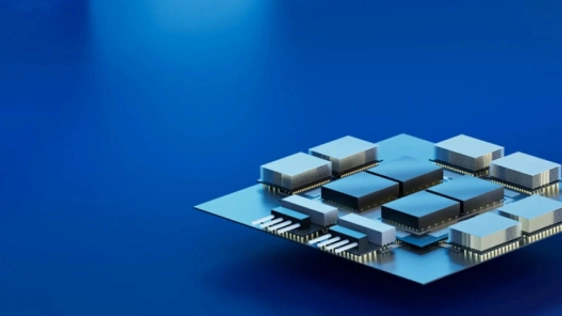 Advanced driver-assistance systems, automated driving functions, sensor fusion, immersive infotainment, and continuous connectivity are transforming cars into high-performance compute platforms, pushing onboard compute requirements far beyond what traditional automotive electronics were designed to handle.
To meet these demands, the industry is turning to chiplets. Rather than relying on highly customized, complex system-on-chip designs per car model, which come at a high development cost, chiplet architectures divide systems into smaller, specialized building blocks that can be mixed, matched, and reused. This modular approach enables a more scalable and cost-effective path to development, allowing tailored systems to be assembled without starting from scratch for every new platform.
Automotive as the stress test
Automotive has been emerging as a particularly illustrative proving ground for the chiplet approach. Its combination of extreme compute demands, stringent safety requirements, long product lifetimes, and strong cost pressure created an ideal environment to mature and validate chiplet‑based architectures.
Given this potential, the automotive domain became the natural stepping stone for imec’s Automotive Chiplet Program (ACP): a pre-competitive initiative focused on reference architectures, interconnect quality, integration reliability, and ecosystem alignment. Today, the ACP brings together 24 partners, including Arm, Audi, AUMOVIO, BMW Group, Bosch, Cadence, Cariad, GlobalFoundries, Infineon, LG Electronics, L&T Technology Services, MIPS, Porsche, Rivian, Siemens, SiliconAuto, Silicon Box, Socionext, STATS ChipPAC, Synopsys, Tenstorrent, TIER IV, Valeo, and Volkswagen — demonstrating clear ecosystem momentum.
It also led to a dedicated Chiplet Accelerator Center (CAC), part of the Advanced Chip Design Accelerator (ACDA), in Heilbronn, Germany. Located at the heart of the European automotive ecosystem, the CAC provides a dedicated environment to accelerate the integration, validation, and scaling of chiplet-based systems, helping bridge the gap between architecture definition and actual demonstration of chiplet solutions.
Alongside these development and validation efforts, the Automotive Chiplet Forum (ACF) serves as a bi-annual conference for broader industry dialogue, knowledge exchange, and ecosystem building around chiplet-based solutions.
Across ACP, CAC and ACF, imec is aiming to accelerate and de‑risk chiplet adoption in the automotive market. This includes selecting the right technologies, aligning industry stakeholders through ACP, and building capabilities for fast prototyping and compliance through CAC. In doing so, the first steps towards a chiplet ecosystem have been taken, with growing momentum as the technology continues to evolve and mature.
From automotive to autonomous edge HPC
But as the option to develop products from a chiplet ecosystem is materializing, it is also becoming clear the need for high-performance edge compute is not unique to automotive.
As AI increasingly moves into real-world environments, the focus shifts toward systems that must sense, decide and act in real time, pushing intelligence closer to where data is generated.
Systems that operate autonomously in complex, dynamic environments, whether in robotics, industrial automation, security or intelligent infrastructure, therefore share a common architecture DNA, and face similar requirements for local, safe and high-performance decision-making. These systems are also typically power constraint. In that sense, automotive and other autonomous domains are increasingly positioned to build on a shared computational foundation.
This convergence also highlights a powerful advantage in scale: as high-performance compute based on chiplets scales most effectively when supported by broader demand, it can create opportunities beyond automotive, reducing risk and unlocking gains in both technical performance, time-to-market and cost efficiency across domains. This trend is by the way not only visible at imec, but shared by a broader industry dynamic as companies are increasingly consolidating around shared compute platforms.
This realization is therefore driving a strategic shift: from an Automotive Chiplet Program (ACP) to an Autonomous Edge Chiplet Program (AECP). Not as a rebranding exercise, but as an acknowledgment that the same foundational HPC building blocks can serve a broader horizon of autonomous, compute-intensive systems. By broadening the addressable market while minimizing re-development efforts, this approach enables greater reuse of technology and accelerates adoption across the ecosystem, for chiplet vendors and system integrators alike.
In doing so, automotive becomes part of a larger autonomous edge computing fabric, one that aligns technical requirements across domains, spreads development costs, and enables an ecosystem capable of sustaining high‑performance compute at the edge.
Build on what is proven, extend where it matters: towards a high-performance computing ecosystem
Expanding the Automotive Chiplet Program (ACP) into the Autonomous Edge Chiplet Program (AECP) is hence about establishing an edge high-performance computing ecosystem that can scale across domains.
Building on the R&D, interoperability principles and ecosystem alignment established within ACP, AECP extends these efforts across domains, enabling chiplets and system architectures to be reused, combined, and validated in a wider set of autonomous applications.
The approach is simple. At the core of AECP is a shared autonomous base developed by imec, providing a common foundation for architecture, interoperability, and system integration. On top of this base, sector‑specific chiplet applications can be developed, enabling tailored solutions across industries while maintaining a consistent and reusable foundation. In this model, the demanding requirements and large-scale deployment context of automotive remain a driving force, while unlocking opportunities for cross-domain reuse, accelerated innovation, and scalable deployment in the specific applications built on top.
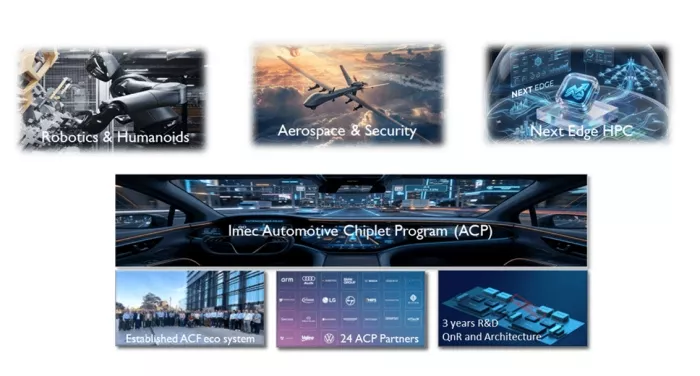
Visual of the AECP rational: a shared chiplet platform enables reuse across domains, while sector‑specific applications, such as robotics, aerospace, security, and HPC, build on top.
This approach not only strengthens cross-industry collaboration but also helps aggregate demand and sustain the scale required for high-performance compute at the edge.
In that sense, AECP is not just an extension of ACP, but the next step toward a shared edge computing foundation, one that enables the next generation of autonomous systems to be built on common, scalable building blocks.
Interested in exploring what the AECP ecosystem can do for you? Or how you can actively contribute? AECP invites partners across industries to help shape the next phase of edge computing and further develop the shared platform on which future autonomous systems will depend.
Feel free to reach out to the imec (contact) teams if you want to discuss further.
Related Chiplet
- DPIQ Tx PICs
- IMDD Tx PICs
- Near-Packaged Optics (NPO) Chiplet Solution
- High Performance Droplet
- Interconnect Chiplet
Related Blogs
- Cadence Commits to Join imec Automotive Chiplet Programme
- Marvell Joins Imec Automotive Chiplet Initiative to Facilitate Compute SoCs for Super-human Sensing
- A look back at the Automotive Chiplet Forum 2025
- 4 takeaways from the 2nd automotive chiplet conference
Latest Blogs
- From horsepower to high-performance compute: automotive chiplets take the leap towards autonomous edge computing
- Designing the Future We Can Verify: A Vision for Multi-Die Design, STCO, and Trustworthy AI
- Wafer-Scale vs. Chiplets: The new war? - Part 2: Two Paths, One Wall
- Wafer-Scale vs. Chiplets: The new war?
- Chiplets 101: An Arteris Guide to Multi-Die Architecture