UCIe Manageability: The Hidden Control Plane of Chiplet Systems

Chiplet-based architectures are quickly becoming the foundation of next-generation silicon systems. While most attention goes to high-bandwidth die-to-die links and data protocols like PCIe or CXL, an equally important layer operates quietly in the background: System Manageability.
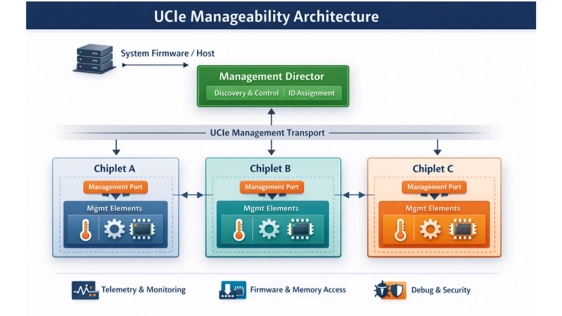 Section 8 of the Universal Chiplet Interconnect Express (UCIe) Specification introduces the manageability architecture, which defines a standardized framework for discovering, configuring, and controlling chiplets inside a System-in-Package (SiP).
For system architects and verification engineers, this layer effectively functions as the control plane of a chiplet system, enabling firmware, debug tools, and system software to interact with chiplets using a consistent management infrastructure.
Why Manageability Matters in Chiplet Systems
Unlike monolithic SoCs, chiplet-based systems often integrate dies from multiple vendors, each with different internal architectures. Without a common management framework, system-level operations such as configuration, monitoring, and debug would require vendor-specific solutions, complicating system integration.
UCIe manageability addresses this by defining a management network spanning all chiplets within the package. Through this network, system firmware can perform essential operations including:
- Chiplet discovery during system initialization
- Chiplet ID assignment and topology configuration
- Remote register access and telemetry collection
- Firmware loading and system configuration
- Debug and diagnostic access
- Security configuration
To read the full article, click here
Related Chiplet
- DPIQ Tx PICs
- IMDD Tx PICs
- Near-Packaged Optics (NPO) Chiplet Solution
- High Performance Droplet
- Interconnect Chiplet
Related Blogs
- Cadence Sets the Gold Standard for UCIe Connectivity at Chiplet Summit '24
- UCIe and Automotive Electronics: Pioneering the Chiplet Revolution
- The Impact of UCIe on Chiplet Design: Lowering Barriers and Driving Innovation
- The Growing Chiplet Ecosystem: Collaboration, Innovation, and the Next Wave of UCIe Adoption
Latest Blogs
- Synopsys Advances Die‑to‑Die Connectivity with 64G UCIe IP Tape‑Out
- UCIe Manageability: The Hidden Control Plane of Chiplet Systems
- Simulation Solutions for the Structural Integrity of Chip Packages
- Overcoming interconnect obstacles with co-packaged optics (CPO)
- Chiplets: 8 best practices for engineering multi-die designs