Chiplets Have Become Essential in a Post-Moore's Law World
November 7, 2024

For a generation of engineers, Moore’s law has proved to be a constant. The industry has continued to advance forward year after year with the promise of performance gains holding steady. That is until recently. With Moore’s law at least slowing (if not outright failing) and Dennard Scaling also long over, the era of guaranteed performance gains has come to an end. With the shift toward a more vertically integrated approach from most of the fabless players, the question of what to do in a post-Moore’s law world is one that needs solving.
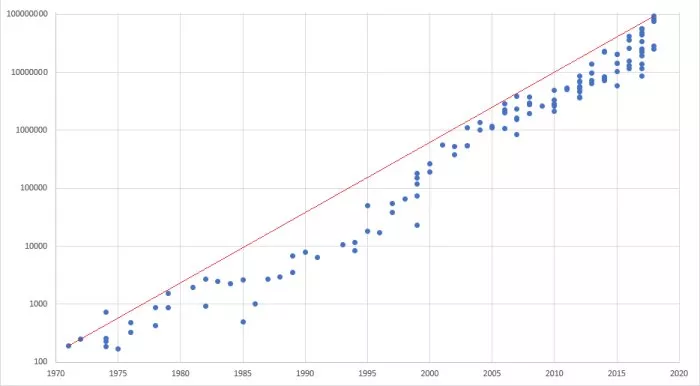
Moore's Law (till 2020)
The Challenges Beyond Moore’s Law
As we’ve pushed transistors to their smallest possible size, we’re facing three big issues:
- Physical Limits: Chips are now so small – down to 2 nm process nodes that the physical limit of shrinking sizes is going to be reached.
- Cost: Designing chips at the leading transistor nodes has become prohibitively expensive.
- Diminishing returns: Smaller doesn’t always mean better anymore. The performance gains from designing on the latest process nodes are no longer proportional to the effort and cost involved.
To read the full article, click here
Related Chiplet
- Interconnect Chiplet
- 12nm EURYTION RFK1 - UCIe SP based Ka-Ku Band Chiplet Transceiver
- Bridglets
- Automotive AI Accelerator
- Direct Chiplet Interface
Related Blogs
- Functional Safety in a Disaggregated World
- The Role of Chiplets in Semiconductor Design: A Modular Approach
- Four Reasons Chiplets Will Take Over the World (and why it hasn’t happened yet)
- Industry Standards for Chiplets and Their Role In Test
Latest Blogs
- Bosch and the chiplet revolution: Enabling software-defined mobility
- Addressing the Biggest Bottleneck in the AI Semiconductor Ecosystem
- Thermal Management in 3D-IC: Modeling Hotspots, Materials, & Cooling Strategies
- 3D Chips: Socionext Achieves Two Successful Tape-Outs in Just Seven Months
- Intel Foundry Collaborates with Partners to Drive an Open Chiplet Marketplace